Call us now :
 Send Inquiry
 Send Inquiry
Electrodialysis application technology
Electrodialysis application technology Specification
- Maintenance
- Easy to operate & maintain
- Power Supply
- AC / DC compatible
- Flow Rate
- Up to client specifications
- Installation
- On-site installation available
- Application
- Electrodialysis
- Control System
- PLC-based automated system
- Material of Construction
- Corrosion-resistant materials
- Membrane Type
- Ion-exchange membranes
- Voltage Range
- Up to 600 V
- Usage
- Industrial water desalination, Wastewater treatment, Chemical processing, Food & Beverage sectors
- Operation Mode
- Continuous / Batch
- Number of Stages
- Single/Multiple as required
- Operating Pressure
- Low (typically < 3 bar)
- Technologies Used
- Membrane Separation
- Automation Grade
- Automatic
- Capacity
- Customized as per application requirement
- Features
- High recovery rate, Low energy consumption, Scalable design
Electrodialysis application technology Trade Information
- Payment Terms
- Telegraphic Transfer (T/T), Letter of Credit (L/C)
- Sample Available
- No
- Packaging Details
- Applications: (1)Surface water purification, brackish water desalination, seawater desalination, and other domestic and drinking water preparation (2)Industrial primary water desalination, industrial water desalination, industrial saline wastewater treatment, reverse osmosis concentrated water desalination and other industrial water preparation, treatment and recycling (3)Removal of salts from chemical/food/pharmaceutical processes to ensure product quality or process sustainability Electrodialysis desalination, Advantage: Membrane anti-pollution, simple pretreatment, high water yield, lower operating costs Electrodialysis concentration, advantages: membrane resistance to contamination, simple pre-treatment, high concentration of concentrated water (small volume) Electrodialysis separation, advantages: membrane resistance to contamination, simple pretreatment, low material loss rate, less generation of saline wastewater
- Main Export Market(s)
- Asia, North America, South America, Eastern Europe, Western Europe, Middle East, Africa, Australia, Central America
- Main Domestic Market
- All India
Electrodialysis application technology About
Electrodialysis process is a combination of electrochemical process and dialysis diffusion process. Driven by the external direct current electric field, using the selective permeability of the ion exchange membrane (that is, the cation can pass through the cation exchange membrane, the anion can pass through the anion exchange membrane), the negative and the cation move to the anode and the cathode, respectively. In the process of ion migration, if the fixed charge of the membrane is opposite to the charge of the ion, the ion can pass through; If they have the same charge, the ions are repelled, thus achieving the purpose of solution desalination, concentration, refining or purification.
Efficient Water Treatment Solutions
Our electrodialysis system applies membrane separation using ion-exchange membranes to deliver high recovery rates while consuming minimal energy. Supported by a PLC-controlled automation grade, the technology is suitable for various sectors, including industrial water desalination and food and beverage processing.
Customizable and Scalable Design
Clients benefit from flexible flow rates, capacity adjustments, and multi-stage options-all tailored to specific application requirements. The robust construction using corrosion-resistant materials guarantees durability and long service life, even in demanding environments.
Hassle-Free Installation and Operation
On-site installation services are available for seamless integration with existing infrastructure. The electrodialysis units are easy to operate and maintain, leveraging automatic operation via advanced control systems.
FAQ's of Electrodialysis application technology:
Q: How does the electrodialysis technology achieve water desalination in industrial applications?
A: The electrodialysis system utilizes ion-exchange membranes and a PLC-based automation system to separate and remove salts from water under low pressure (typically below 3 bar). This results in highly efficient water desalination for varied industrial uses.Q: What are the advantages of using AC/DC compatible power supply with this electrodialysis equipment?
A: AC/DC compatibility provides flexibility in installation sites and ensures uninterrupted operation regardless of power availability. It also helps optimize energy consumption for the specific application environment.Q: When is on-site installation available for electrodialysis units, and what does it include?
A: On-site installation is available upon request and includes integration of the system with your infrastructure, setup of PLC control systems, and initial operation support, ensuring optimal performance from the start.Q: Where can this electrodialysis technology be applied?
A: The system is ideal for industrial water desalination, wastewater treatment, chemical manufacturing, and food & beverage processing. Our units are distributed throughout India, via manufacturers, exporters, suppliers, and traders.Q: What maintenance processes are required for this electrodialysis system?
A: Routine maintenance involves periodic inspection and cleaning of ion-exchange membranes and a check of the automated control system. The design emphasizes easy access for operators, reducing downtime and service requirements.Q: How does the scalable design benefit clients with evolving water treatment needs?
A: Clients can choose between single or multiple stages, adjust flow rates, and expand capacity as required over time. This adaptability ensures that the system meets current needs and accommodates future changes with minimal investment.Q: What are the operational benefits of a PLC-based automated control system?
A: The PLC-based system automates process controls, monitors performance, and minimizes human intervention. This enhances operational reliability, facilitates batch or continuous processing, and simplifies troubleshooting and optimization.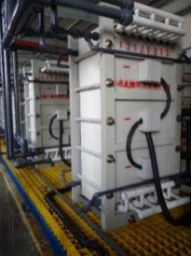

Tell us about your requirement

Price:
Quantity
Select Unit
- 50
- 100
- 200
- 250
- 500
- 1000+
Additional detail
Mobile number
Email

More Products in Application technology of ionic membrane electrodi Category
Polycrystalline silicon industry acid treatment technology
Price 1000.0 USD ($) / Unit
Minimum Order Quantity : 1 Unit
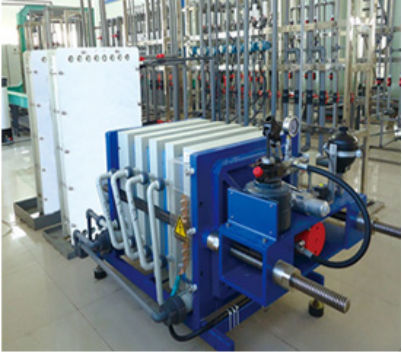
Preparation of organic acids by bipolar membrane electrodialysis
Price 1000.0 USD ($)
Minimum Order Quantity : 1
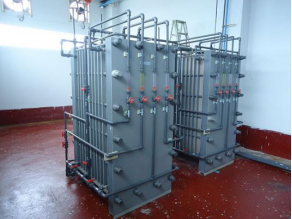
Diffusion Dialysis - Waste Alkali Recovery Technology For Separation and Recovery of Acid/ Alkali Waste Solutions
Price 1000.0 USD ($)
Minimum Order Quantity : 1

 Send Inquiry
Our Products
- Chemical Technology Services and Consulting
- Industrial Membrane
- Factory Construction
- Water Treatment Plant
- Production technology of industrial chemicals
- Application technology of ionic membrane electrodi
- Water Treatment Technology
- Ion Membrane Technique
- Industrial Plant
- Industrial Chemical
- Production Processing Equipment
- Procurement Requirement

Room 1209, Block 14, Hengdafeicuihuating, No 82 Beixiwu Road, Sibaoshan Sub-district,Zibo - 250200, Shandong Sheng, China

Ms. Lynette
(Manager)
Mobile :+8613376439539
 Send Inquiry
Developed and Managed by Infocom Network Private Limited.
